
What Is Generative AI Testing?
Generative AI Testing is the complete process of evaluating AI systems that can generate text, code, images, recommended content, or other forms of content. Its core goal is to confirm that the AI application’s performance meets the enterprise’s business requirements, that it can output useful, safe, and reliable results in all usage scenarios, that it will not cause trouble for the enterprise, and that it can truly assist the people who use it.
Testing RAG Applications
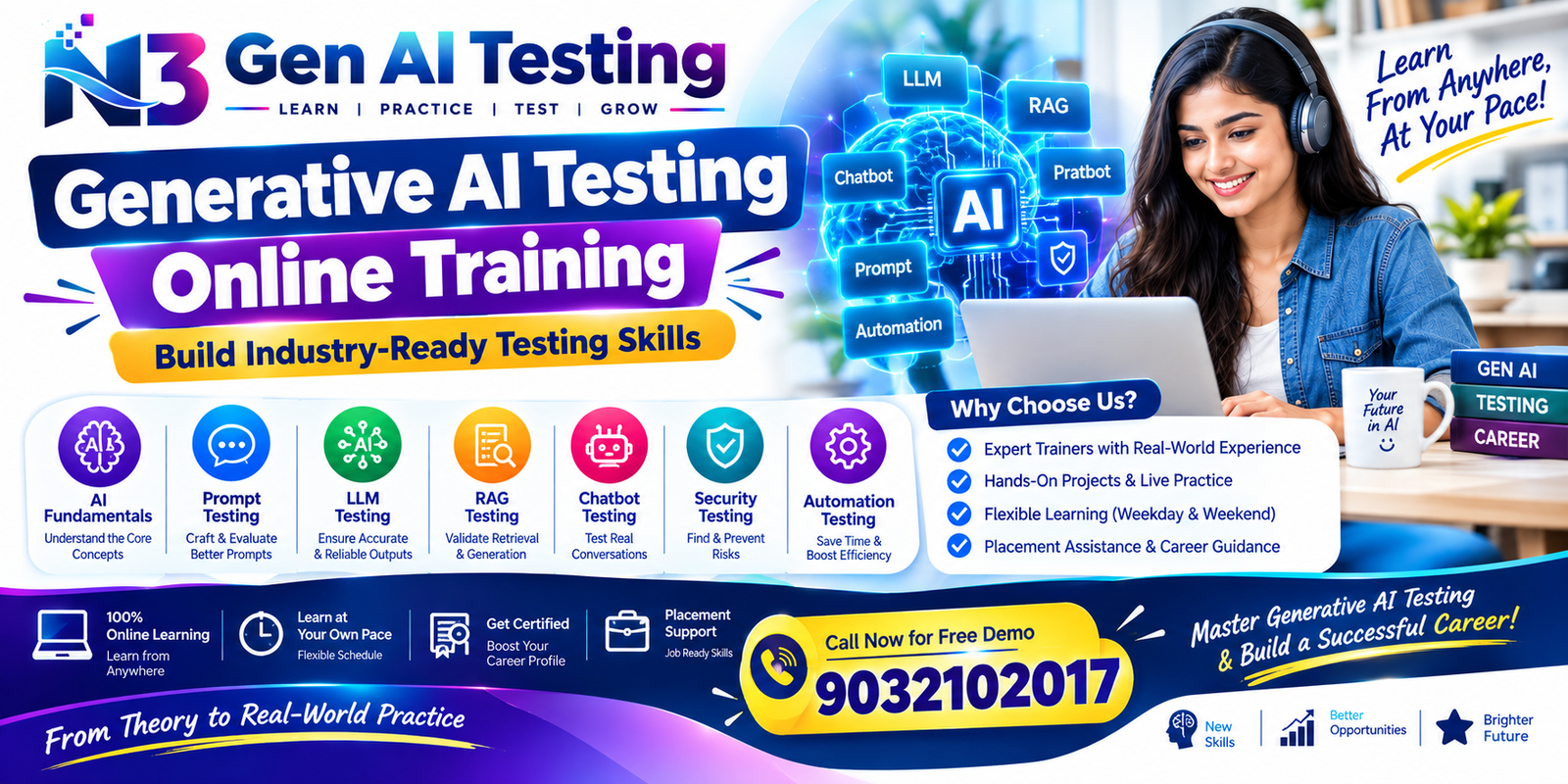
Similarly, when testing a RAG application, testers must validate both the system’s retrieval and generation functions. They need to ensure the platform can crawl relevant source materials, without pulling up a pile of useless information, and that when generating the final output, it uses this information correctly, without misapplying or misinterpreting the materials it retrieves.
A credible Online Generative AI Testing Course will guide trainees through all these validation processes via hands-on, real-world testing scenarios, instead of only teaching dry, abstract theory, so you can start working immediately after completing the course.
Start with the Basics of AI Testing
A credible Online Generative AI Testing Course must start with the core fundamentals of artificial intelligence and Generative AI. You do not need to become a full-time AI researcher, but you must understand the basic concepts that impact your testing team’s ability to evaluate the reliability of AI tools.
Master Prompt Testing Techniques
For many Generative AI applications, prompts are the core support for stable, reliable outputs. Sometimes even a tiny change in wording can lead to an AI response that is completely off-base.
Practice Different Prompt Scenarios
In this Generative AI Testing Online Training, trainees can practice by rewriting the same requirement into various different prompts, then evaluate the quality of the model’s outputs one by one.
The practice content will cover a wide range of scenarios: standard prompts, as well as ambiguous prompts, incomplete prompts, negatively biased prompts, prompts that push the boundaries of system rules, contradictory instructions, and absurd content that a user might input casually.
Evaluate AI Responses
Trainees will learn to compare AI responses to pre-defined quality standards, check that the AI understands all instructions, that its content matches the user’s question, that the information it provides is accurate and useful, and that it does not make unsubstantiated claims—this fabricated content will erode users’ trust in AI tools.
Prompt testing becomes even more critical if a team wants to integrate an AI tool into the company’s daily business processes.
The model’s response quality directly impacts the end-user experience; even a small error could slow down the entire team’s efficiency, or lead to customer dissatisfaction.
Learn Methods for Testing Large Language Models
Large Language Models are the core of many Generative AI applications, and the methods for testing these models are completely different from testing traditional software that produces fixed outputs.
For traditional software, as long as the input content and operating conditions are fixed, the output is generally predictable; you only need to test whether it runs according to preset logic.
But Large Language Models are different: their outputs are affected by many variables, so old testing methods cannot be applied.
Evaluate LLM Performance
Testers must evaluate them from multiple dimensions: whether the output is relevant to the question, whether the content is correct, whether the statements are consistent over time, whether the information aligns with facts, whether it can understand and execute instructions, whether there are security vulnerabilities, and whether it crashes when faced with abnormal inputs.
You can first organize a test dataset, which stores the questions to be tested and the passing standards for each question.
After feeding the questions to the model, you can then check its responses one by one using pre-defined scoring metrics and evaluation methods.
Online AI Testing Training will teach you LLM evaluation techniques, and also help you learn how to design useful test cases for AI applications.
Testing is not just about checking whether the application can run; the core is to confirm that all of the AI’s performance meets the quality standards we set in advance.
Learn to Test Retrieval-Augmented Generation Applications
Retrieval-Augmented Generation has now become a core architecture in enterprise-grade AI applications.
RAG systems first retrieve information from documents, databases, or other knowledge bases, then send this content as context to the AI model.
Relying on these enterprise-specific materials, the AI can output content that better aligns with business needs, instead of only answering based on the inherent knowledge of a general-purpose large model.
Validate RAG Retrieval and Generation
Testing RAG applications requires splitting the entire process into separate links and checking each one individually; you cannot only evaluate whether the final generated response is qualified.
If any earlier step goes wrong, the final output may be incorrect.
You need to confirm that it retrieves all required relevant documents, that it excludes all useless, irrelevant information, that the retrieved content can be passed to the model completely and correctly, and that the final generated response is supported by the retrieved information.
A credible Generative AI Testing Course Online will definitely provide you with hands-on practice opportunities for RAG testing—after all, many enterprise AI solutions rely on the company’s exclusive internal knowledge, not just a general-purpose large model.
Practice Testing AI Chatbots
AI chatbots are one of the most widely accessible, easy-to-reach applications of Generative AI. The intelligent customer service you use when browsing your phone, or the AI assistant that can chat with you, all fall into this category. But testing them goes far beyond checking buttons, interfaces, and API return results—those are basic operations for testing traditional software. Testing AI chatbots requires far more unique work.
Evaluate Conversation Flow and Context
Testers responsible for chatbots must evaluate content that is all tied to new requirements for “human-computer dialogue”: whether the entire conversation flows smoothly, without losing the thread mid-chat; whether it can accurately identify what the user really wants to ask, without mistaking a user’s request to check their package delivery status for a complaint about the delivery worker; whether it remembers all content from previous conversations, without forgetting that the user shared their delivery address ten minutes earlier; whether the response content matches the user’s question, with no off-topic responses allowed; whether it can trigger a pre-prepared backup response plan when it encounters a question it cannot answer, without freezing or crashing; and even whether it can handle a user’s sudden, absurd questions that fall outside preset processes, without responding randomly.
To verify that these requirements are met, testers can design a complete set of conversation scenarios to test, walking through an entire conversation from start to finish, to confirm that the chatbot can consistently remember all context information from earlier in the conversation, without losing track mid-chat.
Test Multi-Turn Conversations
A specific example makes this clear: a user first asks an initial question that mentions multiple options, such as “I want to send a package, what delivery timelines are available?” The robot lists three options: same-day delivery, next-day delivery, and standard shipping. The user then follows up with, “What about the second option?” At this point, the tester must confirm that the chatbot can accurately link “the second option” to the previously mentioned next-day delivery, without misinterpreting it as something else, let alone asking the user “What do you mean by the second option?” These hands-on practice exercises, which exactly match real work scenarios, help new learners build Generative AI Testing Skills that can be directly applied to their jobs, and truly learn how to evaluate all aspects of a chatbot’s performance.
Learn to Test AI Hallucinations
In Generative AI applications, hallucination is a core problem that everyone must address. Almost all Generative AI products in use today encounter this issue. AI models will occasionally generate content that sounds logically coherent and highly credible, but is in fact unsubstantiated or even completely factually incorrect—what people commonly call AI “making things up”.
Understand Enterprise Hallucination Risks
For enterprise-grade AI applications used for office work, hallucination testing is far more important than it is for consumer products. If an AI outputs incorrect information, it could mislead the company’s core business decisions, or cause miscommunication during customer interactions, damaging the quality of customer engagement and causing tangible losses to the company.
Generative AI Testing for Manual and Automation Testing Practitioners
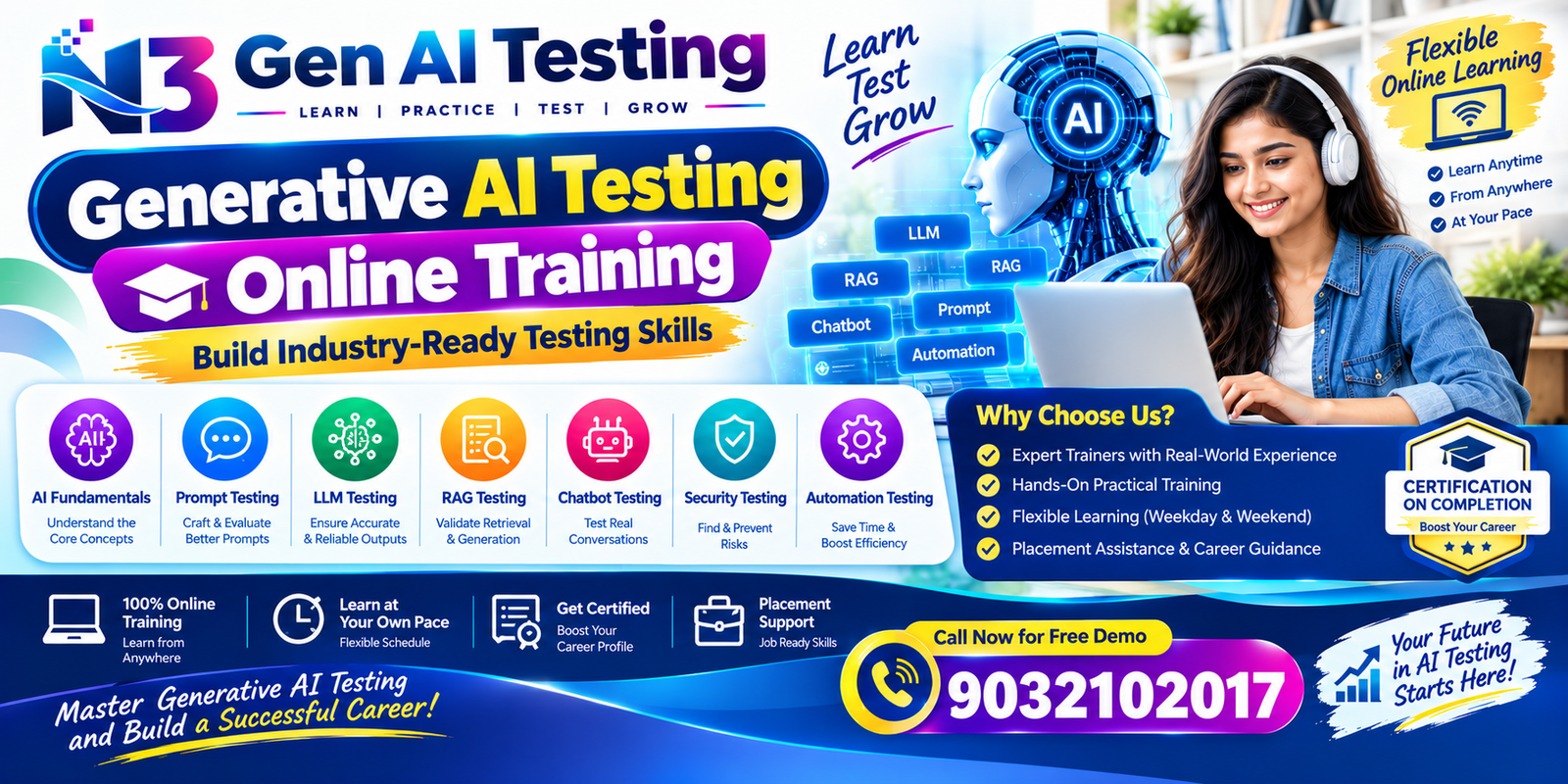
Manual and automation testing practitioners who already understand core testing principles such as test planning, test cases, defect reporting, regression testing, functional testing, and quality assurance do not need to worry that their experience cannot keep up with industry changes. You can build on your existing capabilities and learn a set of high-value new skills through Generative AI Testing. This professional training adds a new layer of capability to the skills you have already mastered, allowing experienced testing professionals to expand their scope of work and take on cutting-edge software projects that others cannot compete for.
Career Opportunities in Generative AI Testing
Demand for this type of talent continues to grow. A number of new roles have emerged to match this emerging field, including AI Tester, Generative AI Tester, AI Quality Analyst, AI Test Automation Engineer, and QA professionals dedicated specifically to AI applications.
Conclusion
Generative AI has completely rewritten the entire process logic of modern software, from design and development to testing. More and more companies are integrating LLMs, RAG applications, AI assistants, chatbots, and AI agents into their core products. Testing these new systems requires mastering a set of professional, cutting-edge skills that traditional software testing training never teaches.
Address: Flat 507, 5th Floor, Annapurna Block, ADITYA ENCLAVE, Kumar Basti, Ameerpet, Hyderabad, Telangana 500038